This is a follow-up to “The Divine Madness of One Thousand Courses,” published in April before Mike’s 1,000th course.
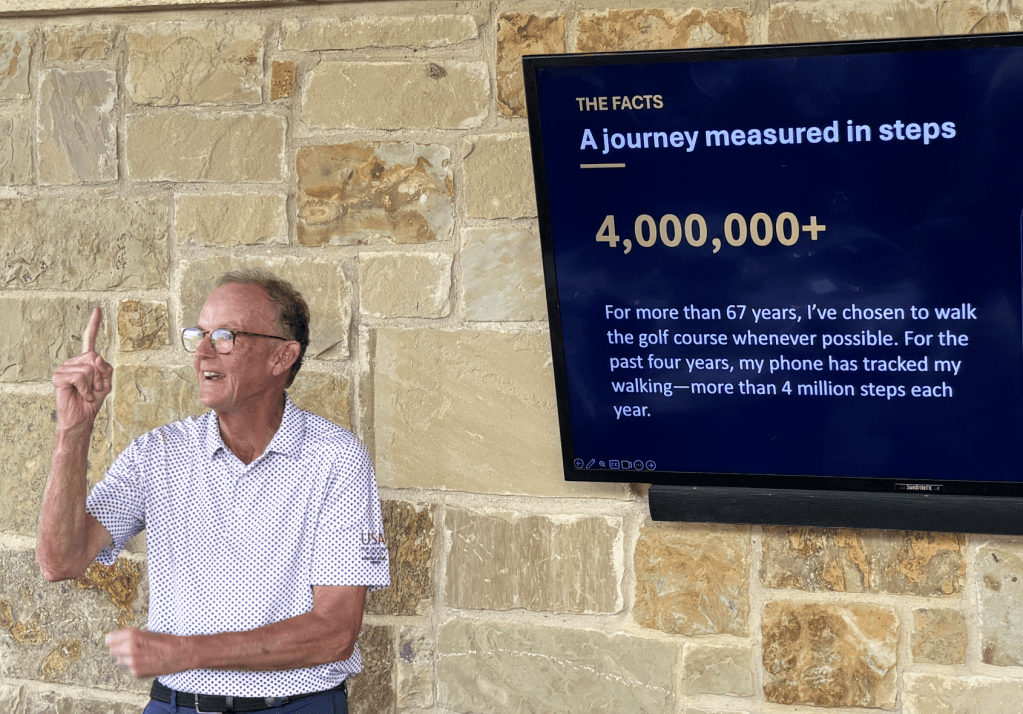
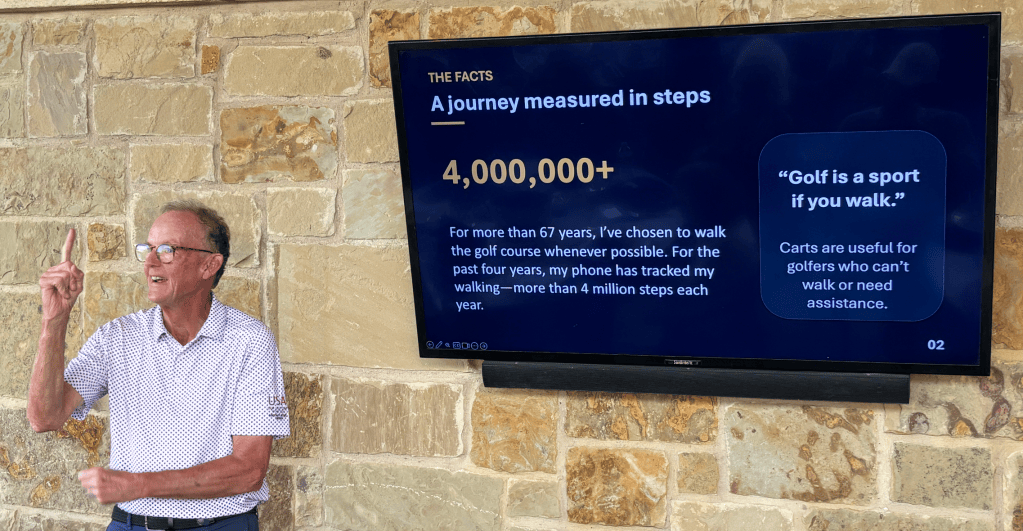
Mike Finneran, the man who taught me golf, fingerspelled a question to the crowd at Lakecliff Golf Club, outside Austin, Texas.
C-A-R-T?
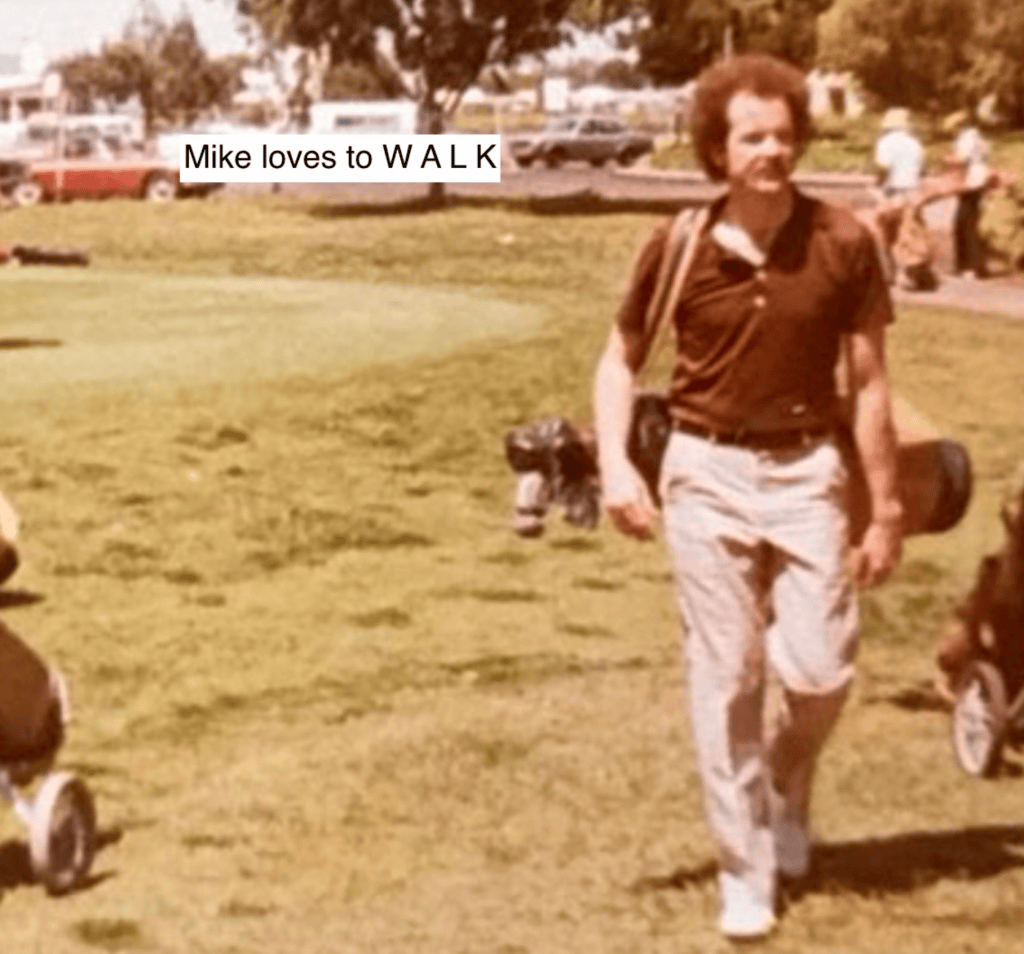
He shook his head with a Cheshire grin. With his left hand, switching hands for emphasis, the way a writer reaches for italics, he spelled the answer. W-A-L-K. The room laughed before he got to the K.
We already knew.
This was the dinner after the round, a celebration of Mike’s 1,000th golf course, for friends who flew in from all over the country. Mike gave a presentation. He had to. Keeping Mike’s oratory from the podium would be like flying to Pebble Beach to hit balls into a net.
He started with facts. And they were interesting facts. His phone counts more than four million steps a year, because Mike believes golf is a sport only if you walk. He is 78 and has swung a club since he was 11. At that pace, a lifetime adds up to roughly a quarter of a billion steps.
Mike has made five holes-in-one. (Most golfers die waiting for their first.) He has played thirty of Vermont’s roughly fifty courses, which is more than most Vermonters.
The facts were also the least interesting thing he shared.
· · ·
A thousand courses is a new course roughly every three weeks for more than sixty years. It is a third of California’s courses and more than half of Connecticut’s. Tour pros travel for a living and still rarely see that many; they return to the same stops every year. Golf magazines profile the handful of amateurs who get there. It takes a lifetime of good health and more than a few blessings.
Here is the best case against it anyway. Rare is not the same as meaningful. With an empty calendar, a credit card, and a thirst for golf-maxxing, a thousand courses become a thousand boxes to check, a thousand logos on a thousand hats, a been-there-done-that.
I concede that. Then I think about the worst scorecard Mike ever kept.
At 11, he played his first round of golf and recorded every stroke, honestly. He shot 188. He still has the card.
Then he broke 150. Then 100. Then 90. Then 80. Then 70. His best round is a 67, which is 121 strokes better than the scorecard he refuses to throw away if you’re keeping score. (He always is.)
Collectors play for accomplishment. Mike plays for the love of the game and for fellowship. A box-checker doesn’t keep a 188.
· · ·
Golf is a convenient excuse for friendship. Most men I know cannot call a friend and say, “I miss you. Let’s talk.” Instead, we say, “Maryland National, 3:57. I’ll give you four strokes. You’ll need six.”
Scratch golfers play to win club championships. Businessmen play to close deals. The rest of us have no business being out there. We come for four hours of conversation under the sun and the peculiar rite of saying “I love you” by mocking each other’s pre-shot routine. (Mine gives them plenty to love. It has been compared to a NASA countdown, minus the liftoff.)
The numbers say we need the excuse more than ever. In 1990, 3 percent of American men reported having no close friends. By 2021, 15 percent did. Researchers have found that having few social ties carries a mortality risk comparable to smoking up to 15 cigarettes a day.
Today, Americans spend only 7 percent of their time outdoors, which affects sleep, metabolic health, mental health, and cardiovascular disease.
And nobody uses the “want to golf?” excuse better than Mike. Along the way, he has made friends outdoors, taken money from them, and then made more friends.
By that science, Mike will outlive us all.
For him, the courses were the passport stamps. The people were the countries.
Mike has won more than fifty Deaf tournaments and kept none of the trophies. What he kept instead were the scorecards, one from every course he played for the first time.
Look at the scorecards long enough, and the count turns into a guest list. Gil Lentz, with Frank Chism and Ed Leighton, the day Mike aced Tularecitos. Jeff Bravin, Bill Stricklen, and Paul Rutowski at Wintonbury Hills. Wayne Miller at Ruby Hill.
Each card holds a story.
· · ·
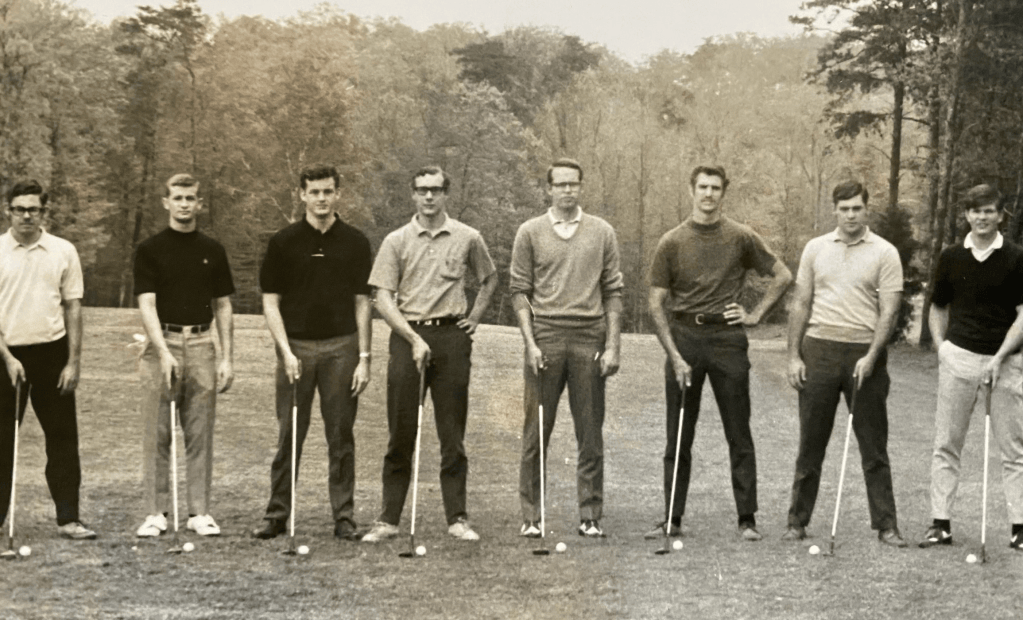
Some stories are history. In April 1968, days after Martin Luther King Jr. was shot, Mike played for Gallaudet against Howard at Langston, a course built in 1939 for Black golfers shut out of Washington, D.C.’s public courses. A group of local teenagers started throwing rocks at him. One narrowly missed his head. His Howard opponent stepped in and told them to back off.
They did.
Some stories are mischief. In 1974, Mike played a 6 a.m. round at Tilden Park with Gil, then a high school senior and one of his students. Gil won his football game that afternoon. His coach never found out.
A trophy remembers the victory. A scorecard remembers the people.
· · ·
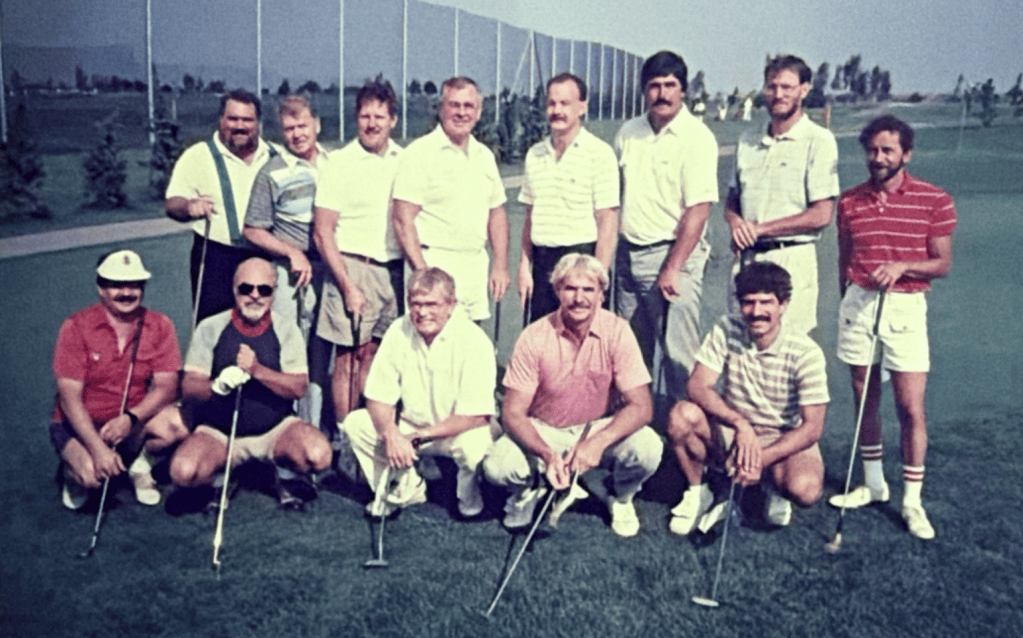
Look at who showed up at Lakecliff. Mike’s friends and admirers from all over the country: women and men, young and old, deaf and hearing, serious golfers, duffers, and people who don’t know a birdie from a pigeon, white-collar and blue-collar, authors and superintendents and veterinarians and teachers and retirees, hilarious Wisconsinites who boast about their (imaginary) spin with their 60-degree wedge.
Mike built that crowd with tee times and trash talk. Mostly trash talk.
Lakecliff’s owner, Laurie Hall Hill-Chapman, stood at the dinner table and burst into tears. She cried in admiration of Mike and in gratitude for the privilege of hosting him.
Usually, the guest thanks the host.
The night’s proceeds went to US Deaf Youth Golf. Where else would they go? The man who has kept a 188 for more than sixty years handed the money to kids who haven’t shot theirs yet.
· · ·
I am far too humble to mention that the team my father and I played on won the scramble. Mike ran the event and set the handicaps, and ours was generous. We accepted it the way a lottery winner accepts the news: immediately, gratefully, and without asking about the odds.
· · ·
Mike knows the thousand courses were never the point. That is why he plans to celebrate his 1,001st, his 1,025th, his 1,050th, and his next left-to-right 8-footer on 18 that takes money from a disbelieving partner.
He has ten states left. (Be patient, Dakotas. Your wait is almost over.) Somewhere out there, someone will ask Mike if he wants a cart.
We already know the answer. He’ll W-A-L-K. Just not alone.


Leave a Reply